Description
■ Product Introduction
The silicone ions leached from the cementitious capillary crystalline waterproofing coating penetrate and diffuse into the concrete along with surface water, reacting chemically with calcium ions in the concrete to form water‑insoluble calcium silicate hydrate (dendritic crystals). These crystals fill the capillary pores and integrate with the concrete to block the internal capillary channels, thereby densifying the concrete and preventing water leakage. Moreover, CCCW has catalytic properties – once it comes into contact with water, it continuously generates chemical reactions, forming crystals that grow and fill the capillary voids inside the concrete. Therefore, even if the concrete structure is locally damaged and leaks, the material will self‑repair through crystallization upon contact with water (repairing cracks up to 0.4 mm). Experiments show that the crystals produced by CCCW can repair cracks of 0.4 mm. Hence, CCCW has self‑healing ability for such cracks without the need for additional waterproofing repairs. CCCW exhibits multiple water‑resistance and self‑repair characteristics, with extremely strong pressure resistance up to 3.0 MPa. The waterproof layer forms an integral system with the concrete surface without separation. The material can fully absorb moisture from the concrete surface to participate in its crystallization reaction, preventing hollowing. Because it is breathable yet watertight, it can be cured simultaneously with the concrete structure.
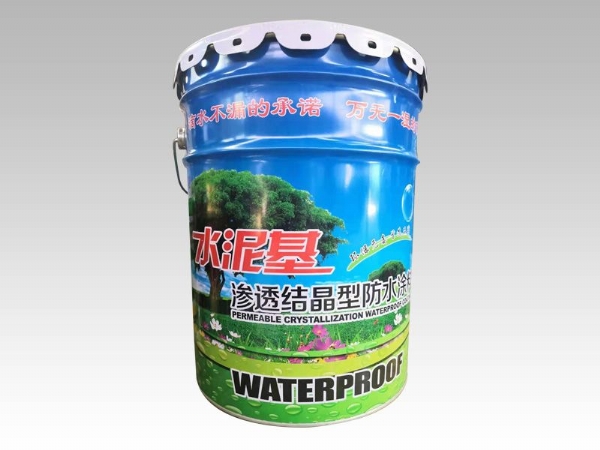
Cementitious capillary crystalline waterproofing coating is a powder‑based rigid waterproofing material made from special cement, quartz sand, etc., mixed with various active chemicals. When mixed with water, the active chemicals penetrate into the concrete through carrier water, forming water‑insoluble crystals that block capillary pores, thus densifying and waterproofing the concrete.
■ Product Characteristics
-
Inorganic material – a permanent, never‑failing waterproofing system.
-
Long‑term resistance to high water pressure – up to 300 meters water head.
-
Self‑healing ability – can self‑repair concrete cracks up to 0.4 mm.
-
Excellent performance on the negative side (back side) of water, solving many basement leakage problems.
-
Non‑toxic, environmentally friendly, anti‑corrosion, acid/alkali resistant; can increase concrete strength.
-
No need for a leveling layer or protective layer – saves construction time, accelerates project progress, significantly reduces overall construction costs.
-
A never‑failing waterproofing system – continues to work even after other waterproofing systems have failed.
-
Penetrating ability – enters the concrete through chemical reactions to form crystals that block capillary pores.
■ Application Scope
Waterproofing of new construction projects such as tunnels, diaphragm walls, cable tunnels, underground culverts, industrial and civil building basements, underground garages, bathrooms, reservoirs, pools, swimming pools, elevator pits, etc. Repair of structural cracks (micro‑cracks), water seepage points, holes; correction of concrete structure defects; corrosion protection of concrete structures and cement mortar.
■ Construction Method
Substrate preparation
The substrate must be completely cured, sound, dust‑free. Remove laitance, oil, grease, release agents and other contaminants that could affect waterproofing. Before construction, thoroughly wet the concrete substrate with clean water (no standing water on the surface during application). This accelerates the chemical reaction between the active ingredients and substances in the concrete, and improves adhesion.
Mixing
According to the specific application method, mix the powder with clean water following the exact water‑to‑powder ratio. Allow the mixed slurry to stand for 5 minutes, then mix briefly before use. Mix thoroughly and evenly – this is essential for quality.
Brushing
Apply carefully to details such as cracks, gaps, rough surfaces. Use a stiff bristle brush or other tool to apply the mixed coating evenly on the substrate in a consistent direction, without puddles. Application rate: 1.0–1.5 kg/m². After the first layer has dried/hardened, apply the second layer. Before applying the second layer, wet the previous coat with water. Apply the second layer in a direction perpendicular to the first.
Trowelling
Apply the slurry with a trowel at a rate of 1.2–1.8 kg/m². Do not miss any areas.
Dry‑shaking (dry sprinkling)
Dry‑shake application is limited to use before concrete is poured, or after compaction/levelling but before the concrete hardens. It must be applied before initial setting. Evenly sprinkle the powder onto the wet concrete surface at a rate of 1.2–1.5 kg/m², then compact and trowel immediately. After final setting, inspect for defective areas and repair. In sunny exposure, water cure. Ensure even sprinkling.
Curing
Proper curing is critical for durability and quality of the mortar layer. To prevent cracking or powdering of the coating surface, keep the coating moist. Begin curing as soon as the coating starts to harden. Spray water mist on the coating 3–4 times a day; increase frequency in hot weather. Protect from rain, windblown sand, sewage and frost for two days after application. For concrete elements that will contain liquid, after three days of curing, allow an additional two weeks before use.
■ Precautions
-
Substrate preparation is crucial for successful waterproofing. Ensure the substrate is free of dust, grease, holes, cracks, irregular joints, and mesh cracks. Repair defects. High‑pressure water jet can be used to remove surface deposits, honeycombs, loose areas.
-
Thoroughly wet the substrate before application to help the active ingredients penetrate with the water. However, ensure no standing water on the surface.
-
First treat leak points, cracks, and joints, then apply to large areas. Increase material dosage at critical waterproofing areas for reinforcement or crack resistance.
-
Ensure a complete coating layer and correct application rate.
-
Do not apply at ambient temperatures below 5°C.
-
If a decorative or other surface layer is required on the outside of the waterproofing, a trowelled application can be used to increase density and cohesion of the crystalline coating, ensuring good adhesion of the decorative layer without hollowing or delamination.
-
Curing is a key factor for achieving the required waterproofing performance. Begin water curing as soon as the coating surface dries to the touch. Cure for 2–3 days, watering every 4 hours. Alternatively, cover with damp burlap or straw mat.
-
For long‑term immersion, allow the coating to cure for at least 14 days before filling with water.
■ Storage, Transport and Packaging
-
Non‑hazardous material, non‑toxic, non‑polluting. Safe to transport. Protect from rain, collision, and damage to packaging.
-
Store in a cool, dry warehouse; avoid prolonged exposure to air and contact with water.
-
Shelf life: six months.
-
Packaging: 25 kg/bag.